
Why Most Indian D2C Brands Fail at Scaling Meta Ads – The Real Psychology, Economics, and Systems Behind Sustainable Ecommerce Growth
Most Indian D2C brands do not fail because Meta ads stop working.
They fail because paid advertising exposes the weakness already existing underneath the business.
Most founders believe scaling Meta ads is primarily a media buying challenge. They assume success depends on finding winning creatives, lowering CAC, increasing ROAS, testing hooks, or scaling budgets aggressively. But sustainable ecommerce growth is not built through advertising tactics alone.
Performance marketing is not a growth engine.
Performance marketing is an amplification engine.
Meta ads amplify the strength or weakness already existing underneath the business.
If positioning is weak, Meta ads amplify weak positioning.
If consumer trust is weak, Meta ads amplify skepticism.
If retention systems are weak, Meta ads amplify churn.
If operations are unstable, Meta ads amplify operational fragility.

The Performance Marketing Illusion
The internet created a dangerous illusion around ecommerce growth.
Founders constantly search for:
- winning creatives
- scaling hacks
- high ROAS campaigns
- cheap CPMs
- agency tricks
- viral ads
But sustainable ecommerce growth is rarely created through tactical optimization alone.
The strongest brands scale because they build:
- psychological trust
- consumer memory
- emotional differentiation
- identity resonance
- retention ecosystems
- brand authority
Advertising only amplifies those strategic advantages.
Attention Saturation Economics
Modern consumers are psychologically overloaded.
Every day consumers encounter:
- AI-generated content
- UGC ads
- influencer campaigns
- discount offers
- performance creatives
- viral hooks
Human attention is no longer scarce.
Meaningful emotional attention is.
This is one of the biggest reasons Meta advertising has become increasingly difficult.
The brain automatically filters:
- generic messaging
- repetitive hooks
- predictable creatives
- surface-level branding
- emotionally identical brands
This means emotional differentiation is becoming more important than advertising volume.
The Relationship Between Branding and Performance Marketing
Many founders still separate branding and performance marketing into independent departments.
That distinction no longer makes sense.
Branding directly affects performance marketing efficiency.
Strong branding reduces:
- consumer skepticism
- conversion friction
- creative fatigue
- advertising resistance
While improving:
- trust
- retention
- brand memory
- word-of-mouth
- click quality
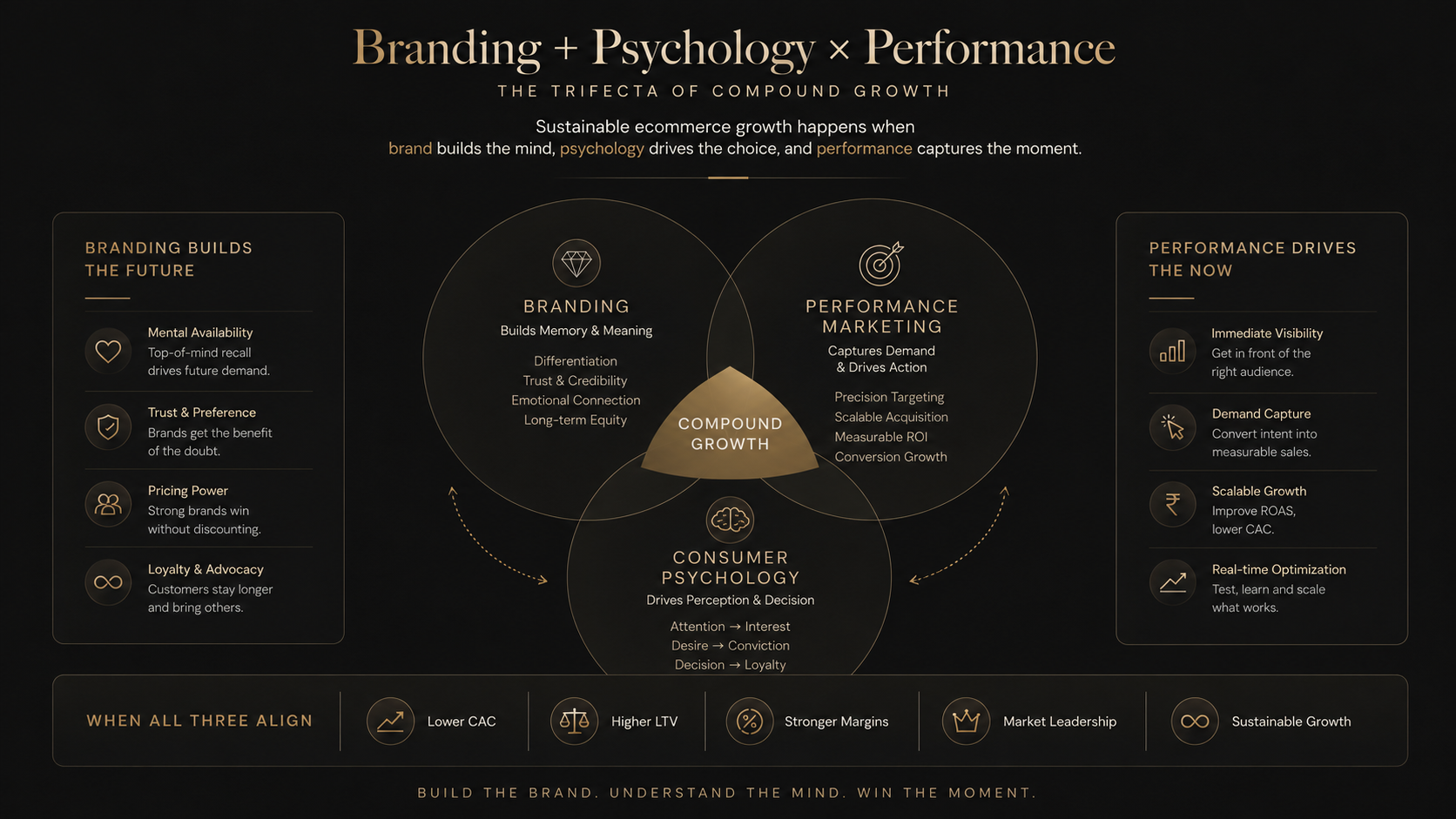
Strong brands often experience lower effective CAC over time because consumers already trust the brand before clicking the ad.
Weak brands force the advertisement to do all the psychological work.
That makes scaling unstable.
Emotional Commoditization and CAC Inflation
Most Indian D2C brands are emotionally identical.
They use:
- similar editing styles
- similar UGC structures
- similar emotional messaging
- similar hooks
- similar offers
This creates emotional commoditization.
When consumers cannot emotionally distinguish between brands, purchasing decisions become increasingly price-sensitive.
This increases:
- CAC
- advertising competition
- creative fatigue
- consumer skepticism
The brands that escape CAC inflation most effectively are the brands that create stronger emotional distinction.
The Real Reason Creative Fatigue Happens
Creative fatigue is not simply audience repetition.
Creative fatigue is emotional predictability.
When advertisements stop creating emotional novelty, attention quality collapses.
Human attention is driven through:
- novelty
- contrast
- identity relevance
- aspiration
- uncertainty
- transformation
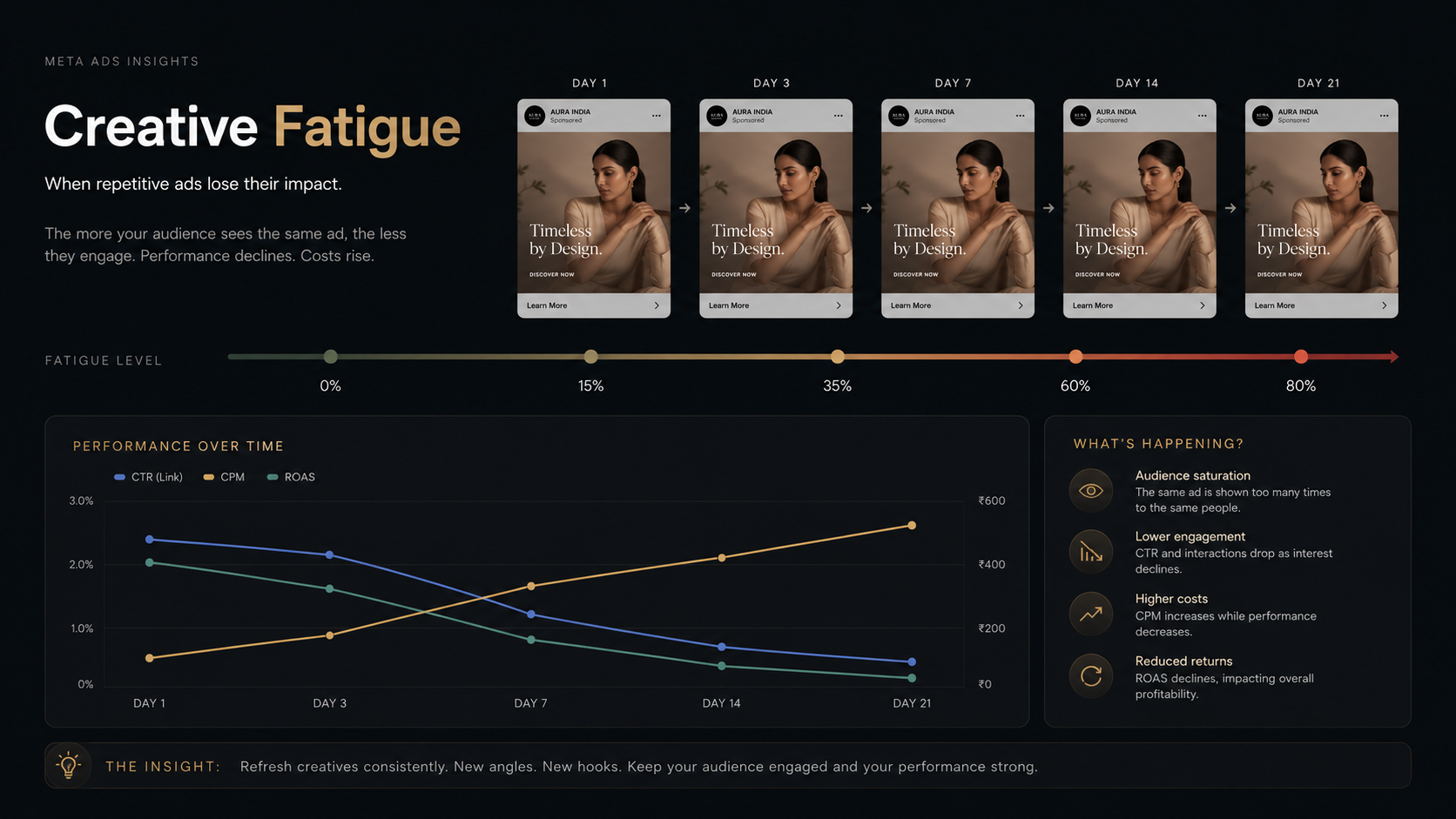
If every creative feels psychologically repetitive, the brain begins filtering the advertisement automatically.
The strongest brands build scalable creative ecosystems instead of depending on one winning ad.
Those systems include:
- founder storytelling
- identity-based messaging
- educational content
- belief-driven narratives
- customer transformation stories
“`
“`html
Why Most Landing Pages Destroy Conversion Momentum
One of the biggest hidden reasons Meta ads underperform is landing page inconsistency.
Most ecommerce brands think landing pages are product information pages.
They are not.
Landing pages are psychological continuity systems.
The advertisement creates emotional momentum.
The landing page must continue that emotional momentum without interruption.
But most Indian D2C websites immediately destroy continuity through:
- weak visual hierarchy
- generic layouts
- slow loading speeds
- poor copywriting
- trust gaps
- information overload
- confusing product storytelling

This creates cognitive interruption.
And cognitive interruption destroys conversions.
Conversion Continuity Psychology
The emotional promise created inside the advertisement must continue naturally throughout the website experience.
If the advertisement creates aspiration, the landing page must continue aspiration.
If the advertisement creates premium perception, the website must continue premium perception.
If the advertisement creates urgency, the checkout flow must continue urgency.
Consumers should feel psychological continuity throughout the entire buying journey.
Most brands fail because the emotional experience collapses after the click.
The Hidden Relationship Between Trust and Conversion Rates
Trust is one of the most misunderstood variables in ecommerce.
Most founders think trust is primarily visual.
But trust is systemic.
Consumers evaluate trust through:
- visual consistency
- website sophistication
- brand language
- social proof
- customer reviews
- delivery expectations
- founder credibility
- community validation
Strong trust systems reduce advertising friction dramatically.
Weak trust systems force brands to constantly compensate through:
- discounts
- aggressive urgency
- high ad spend
- repetitive retargeting
ROAS Is One of the Most Dangerous Metrics in Ecommerce
Modern ecommerce culture has become dangerously obsessed with ROAS.
Founders constantly optimize:
- ROAS
- CAC
- CTR
- CPMs
while ignoring deeper business economics.
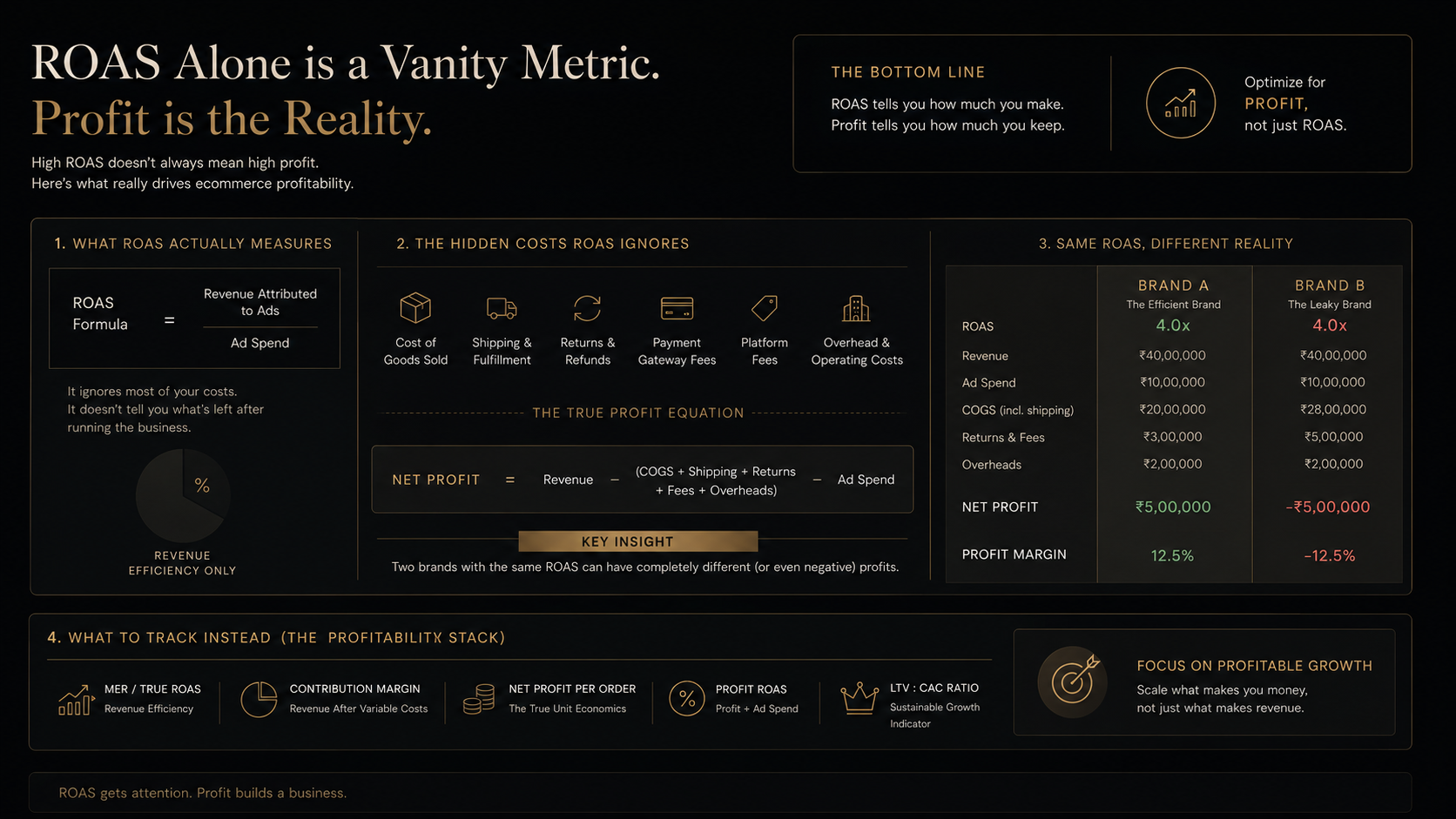
A brand can generate excellent ROAS while still becoming financially unstable.
Because profitability is not determined through advertising metrics alone.
It is determined through:
- contribution margins
- retention systems
- cash flow stability
- inventory management
- operational efficiency
- refund rates
- customer lifetime value
This is one of the biggest reasons many D2C brands experience temporary growth before eventually collapsing operationally.
The Operational Fragility Loop
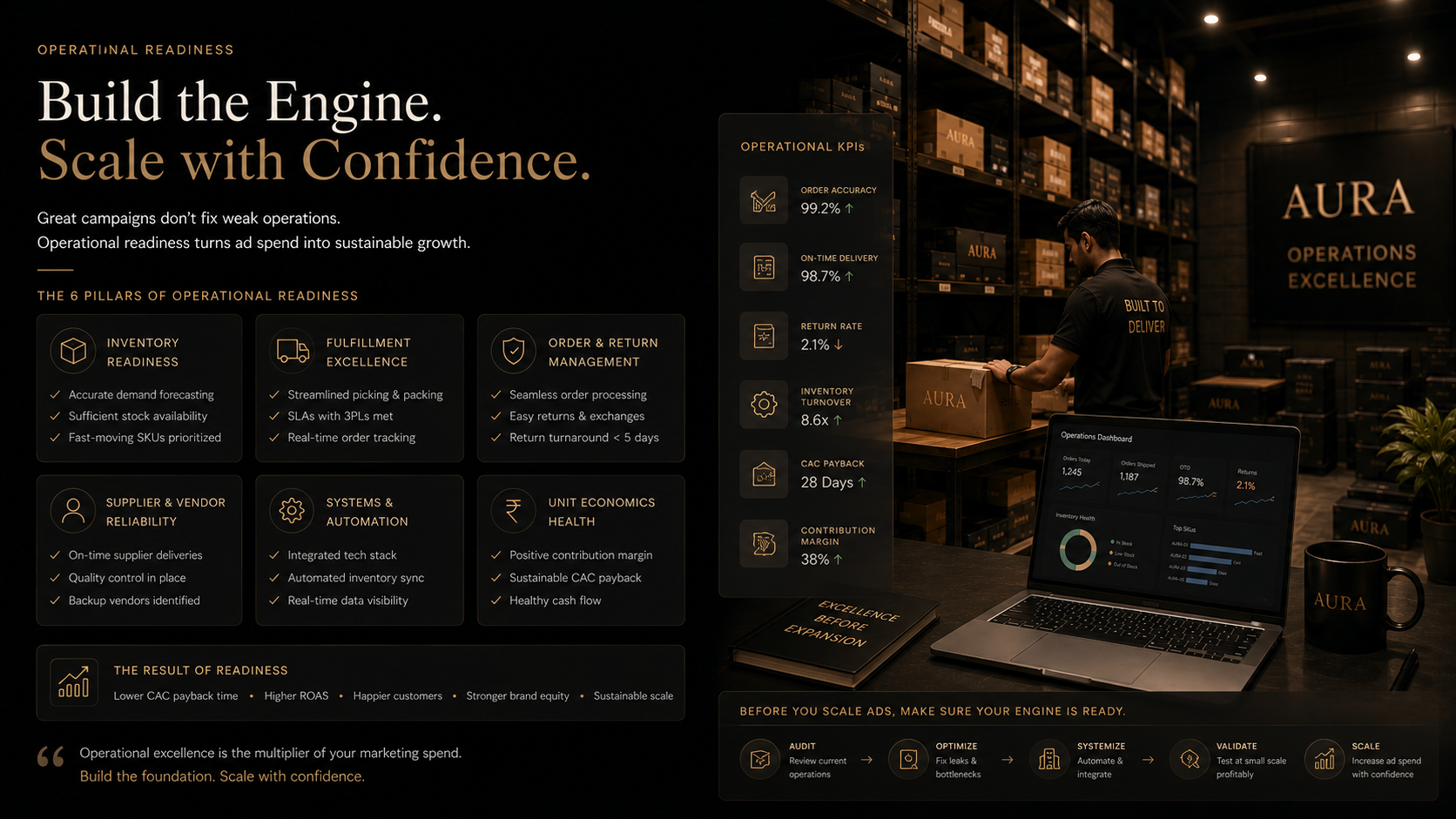
Many brands aggressively scale Meta ads before building backend stability.
This creates operational fragility.
As order volume increases:
- fulfillment delays increase
- customer support weakens
- refund rates rise
- inventory pressure increases
- cash flow becomes unstable
Eventually this damages:
- customer trust
- retention
- future conversion efficiency
- brand reputation
Advertising can create rapid growth.
But operations determine whether growth survives.
“`
“`html
Retention Is More Important Than Acquisition Efficiency
Most Indian D2C brands are structurally overdependent on acquisition.
This creates unstable business economics.
Acquisition is expensive.
Retention compounds.
The strongest brands build systems that increase:
- repeat purchase behavior
- consumer memory
- brand familiarity
- community attachment
- emotional loyalty
Most brands focus on getting customers.
Very few focus on becoming psychologically memorable.
That difference changes long-term profitability dramatically.
Why Customer Memory Matters More Than Viral Reach
Many founders obsess over virality.
But virality without memory is operationally weak.
Consumer memory compounds.
The strongest brands continuously reinforce:
- visual identity
- brand language
- positioning consistency
- emotional tone
- consumer familiarity
This creates subconscious trust accumulation.
And subconscious trust dramatically improves future advertising efficiency.
The Attribution Problem in Modern Ecommerce
One of the most dangerous assumptions in performance marketing is believing attribution equals causation.
Just because Meta ads generated the conversion does not mean Meta ads alone caused the purchase.
Consumer decisions are influenced through multiple psychological touchpoints:
- brand familiarity
- community trust
- social proof
- content ecosystems
- founder authority
- consumer reviews
- visual memory
Many conversions happen because consumers already trusted the brand before clicking the ad.
This is why strong brands usually scale advertising more efficiently over time.
Why AI Search Changes Content Strategy Completely
The future of search is changing rapidly.
Traditional SEO focused heavily on:
- keyword density
- backlinks
- technical optimization
- search intent matching
Those things still matter.
But AI retrieval systems increasingly prioritize:
- information gain
- semantic depth
- topic interconnectedness
- conceptual relationships
- authority consistency
- original perspective
This changes the economics of content creation completely.
Generic SEO content becomes replaceable because AI systems can already summarize generic information instantly.
The real competitive advantage now comes from:
- deep strategic thinking
- cross-domain synthesis
- consumer understanding
- original frameworks
- psychological insight
- operational realism
The Rise of Authority Ecosystems
The strongest modern brands are increasingly building authority ecosystems instead of depending only on paid acquisition.
This includes:
- educational content
- founder-led media
- community ecosystems
- search visibility systems
- consumer education
- strategic thought leadership
This creates compounding trust advantages.
Brands that depend entirely on paid advertising remain vulnerable to:
- platform changes
- algorithm instability
- CAC inflation
- auction competition
- creative fatigue
But brands that build authority ecosystems create long-term audience ownership.
The Future of Indian D2C Brands
The next generation of successful Indian D2C brands will not win simply through better advertising.
They will win through:
- better consumer understanding
- stronger emotional positioning
- trust ecosystems
- authority content
- retention infrastructure
- operational excellence
- community-driven growth
Performance marketing alone will no longer create durable competitive advantage.
Strategic depth will.
Final Thoughts
Most Indian D2C brands fail at scaling Meta ads because they misunderstand what performance marketing actually is.
Performance marketing is not simply media buying.
It is the visible outcome of:
- consumer psychology
- branding
- positioning
- retention systems
- operational readiness
- trust architecture
- customer experience
- authority ecosystems
The future belongs to brands capable of combining:
- psychological relevance
- strategic differentiation
- consumer trust
- operational excellence
- authority-driven content systems
because long-term ecommerce growth is no longer driven only by attention.
It is driven by trust, memory, emotional resonance, and strategic depth.
“`
“`html
The Founder Psychology Problem in Indian D2C
Many Indian D2C founders unconsciously build businesses optimized for short-term validation instead of long-term strategic stability.
This creates dangerous decision-making patterns.
Founders become addicted to:
- daily ROAS tracking
- revenue screenshots
- viral creatives
- temporary growth spikes
- scaling excitement
But sustainable ecommerce growth rarely feels exciting operationally.
Strong businesses are usually built through:
- systems consistency
- operational refinement
- consumer understanding
- retention infrastructure
- brand memory accumulation
- trust compounding
Most founders unconsciously prioritize visible metrics because visible metrics create emotional reassurance.
But the most important growth variables are often invisible initially.
For example:
- customer trust compounds slowly
- brand memory compounds slowly
- community trust compounds slowly
- positioning compounds slowly
- retention compounds slowly
Yet these eventually become the strongest competitive advantages.
The Hidden Economics of Premium Perception
Most Indian ecommerce brands compete aggressively on pricing.
This creates margin pressure, discount dependency, and weak customer loyalty.
But premium brands operate differently psychologically.
Premium perception changes:
- consumer expectations
- comparison behavior
- conversion psychology
- pricing sensitivity
- brand trust
Strong premium positioning reduces comparison shopping.
And reducing comparison shopping improves conversion efficiency dramatically.
This is why many luxury brands maintain stronger profitability despite higher pricing.
They are not competing primarily on product utility.
They are competing on emotional meaning and identity alignment.
The Trust Architecture Framework
Modern ecommerce growth increasingly depends on what can be called trust architecture.
Trust architecture is the complete system through which consumers subconsciously evaluate credibility.
This includes:
- website sophistication
- brand consistency
- founder visibility
- customer experience
- community validation
- social proof
- content quality
- delivery experience
Weak trust architecture increases conversion friction.
Strong trust architecture improves:
- conversion rates
- retention
- consumer confidence
- word-of-mouth
- advertising efficiency
This is one of the biggest reasons why branding and performance marketing can no longer be separated strategically.
Why AI-Generated Marketing Will Increase The Value of Authentic Brands
As AI-generated content becomes more common, consumers will increasingly encounter:
- generic advertising
- repetitive messaging
- surface-level branding
- emotionally empty content
This creates what can be called authenticity scarcity.
When generic marketing becomes abundant, authentic strategic thinking becomes more valuable.
The brands that win over the next decade will not simply produce more content.
They will produce more meaningful content.
This is why authority-driven publishing ecosystems are becoming increasingly important.
Brands capable of building:
- trust
- educational value
- consumer understanding
- strategic insight
- founder credibility
will increasingly dominate both AI search visibility and consumer trust simultaneously.
The Future of Search, Commerce, and Consumer Attention
The future of ecommerce will increasingly revolve around semantic authority.
Search engines and AI retrieval systems are becoming increasingly capable of evaluating:
- topical depth
- conceptual understanding
- semantic relationships
- information gain
- authority consistency
This means shallow SEO content will become increasingly ineffective.
Generic information is becoming infinitely reproducible.
But deep insight remains scarce.
The brands that dominate future search ecosystems will not simply publish more articles.
They will build interconnected authority systems across:
- consumer psychology
- performance marketing
- branding
- ecommerce economics
- retention systems
- operational strategy
This is how long-term semantic authority is built.
The Real Future of Performance Marketing
The future of performance marketing is not simply better targeting or better creatives.
The future belongs to brands capable of combining:
- consumer psychology
- strategic positioning
- authority content
- operational excellence
- retention ecosystems
- trust architecture
- community building
Performance marketing is no longer an isolated advertising discipline.
It is now the visible output of the entire business ecosystem underneath the brand.
The brands that understand this early will build stronger long-term competitive advantages while others continue chasing temporary advertising hacks.
“`